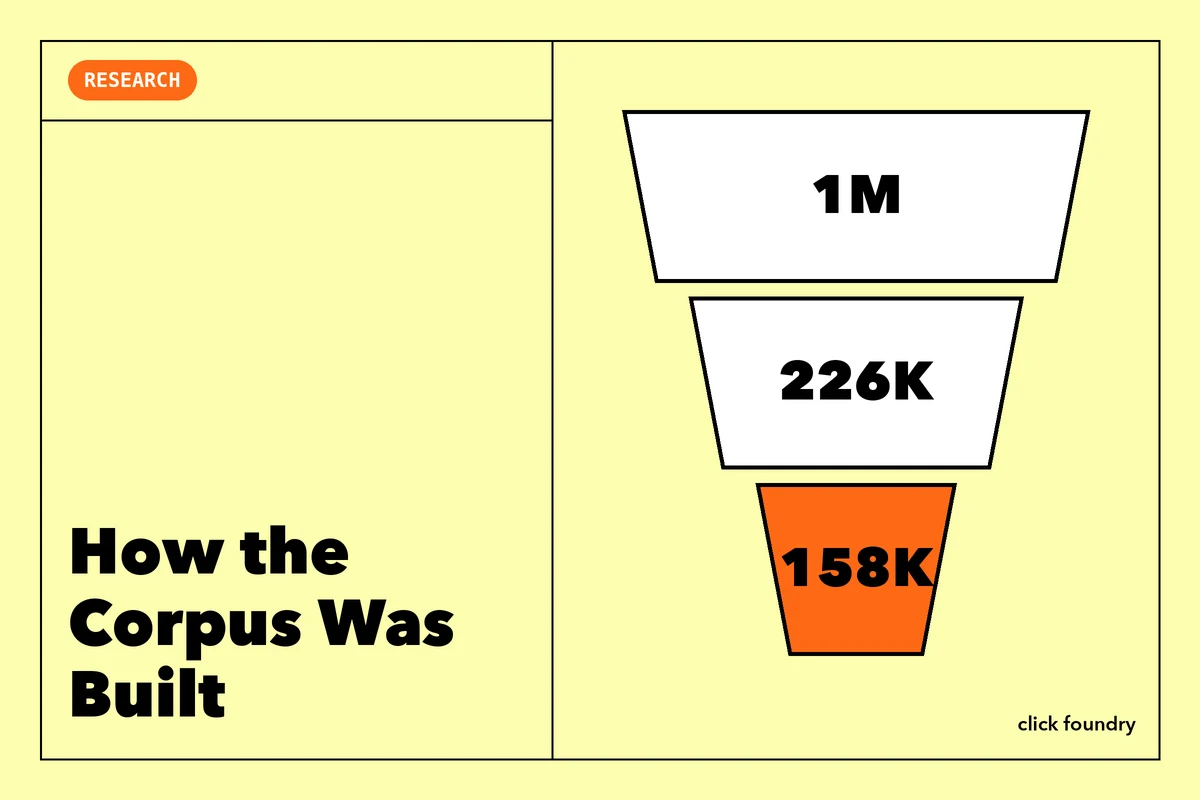
How we got all this information
The list of a million domains is Tranco (tranco-list.eu), which averages several popularity rankings. From there:
| Stage | Domains |
|---|---|
| Tranco top 1M | 1,000,000 |
| After the domain filter (CDNs, ad networks, a handful of adult domains by name) | 995,467 |
| Alive on a fetch | 710,284 |
| English | 323,568 |
| Content-qualified (has CSS, not thin, not a login wall, not parked) | 125,721 |
| Rendered successfully in headless Chrome, including a stealth re-render pass that recovered bot-blocked domains | 226,643 |
| Excluded afterwards: one operator’s 35,611-site link farm, 9,263 gambling, 8,138 adult, 9,102 placeholder pages, 3,955 bot walls, 1,085 parked, 923 error pages, 279 redirect shells | 68,356 |
| Clean corpus | 158,294 |
Each site was rendered once, homepage only, in headless Chrome, in 17 batch runs between 29 April and 27 May 2026, plus 77 re-rendered in October. The viewport was 1280 by 800 on about two thirds of renders and 1366 by 768 or 1920 by 1080 on the rest, because the recovery pass rotated viewports with its user agents. From each render I kept the HTML, every stylesheet (external and inline, deduplicated by content hash: 1,734,591 unique sheets, 56.7 GB), the browser’s computed style for one representative element of each of eleven roles (body, a, p, h1, h2, h3, button, input, header, nav, footer), and every color used, by role, with how many elements used it. The stylesheets were parsed separately for media queries, units, clamp, container queries and so on.
Sectors come from an LLM pass (DeepSeek via Ollama, 84 labels fixed by hand) that read each page and assigned one of 28 sectors and one of 12 site types. The earlier keyword classifier agreed with it on only 34% of sites, which is why I don’t use the keyword labels.
Caveats, because there are real ones:
- Homepages only. An article page or a product page has different typography. Everything here is the front door.
- English only. 323,568 of 710,284 live sites. The CJK and RTL web have different norms and aren’t in this.
- One moment. April to May 2026. No trend over time; this is a snapshot.
- Desktop viewport. The computed styles are the desktop styles. Mobile type sizes and spacing are in the CSS but not in the computed-style tables.
- One element per role. The “h1” is the first H1, and in the Stage 6 tables the “button” is the first button-like element in the DOM, which is often a menu toggle. That’s why one H1 in seven is under 24px; it’s real, but it’s the first element, not the hero. The Buttons section no longer uses that button: it was re-measured with a designed-button definition (border or fill, plus padding, outside header, nav, footer and cookie bars), and the first-pass figures stay only as the comparison column.
- Sheet counts include libraries. When I say a site has 17 breakpoints or 22 stylesheets, that includes every plugin and library it loads. That’s a true statement about what the browser receives and a misleading one about what the designer decided, and I’ve tried to say which is which.
- Detection is pattern matching. Framework, CMS, theme and library detection work from file names, class prefixes and known colors. They miss renamed or bundled builds and they can double-count a site that ships a component library.
- The link farm was found by hand. The 35,611-site template was only noticed because one number looked too neat. There may be smaller ones still in the clean set; none big enough to move a top-ten number, as far as I can tell.
Everything is in three SQLite databases on my desk and queryable. If a number here looks wrong, the query that produced it is listed below and can be re-run.
Sources
All numbers are from the clean corpus of 158,294 sites (design.db
domain_tags minus excluded_domains) unless a
table says otherwise. Scripts live in pipeline/reportv2/.
-
Fonts. Top families per role, fonts per site, pairings, H1
weight and size bands, uppercase shares:
compute_v2.py→results_v2.json(top_fonts,font_count,pairings,weights,h1_size,uppercase,body_mode), fromcomputed_styles. Google Fonts, Typekit and Bunny links, system-stack shares, H1 letter-spacing, H1-to-paragraph ratio, exact size histograms:article_probe.py→article_results.json(google_fonts_link_sites,typekit_sites,bunny_sites,body_font_system,site_font_system,letter_spacing,h1_p_ratio,h1_px,p_px), fromstylesheet_linksandcomputed_styles. Font-size units per sheet and site:fontsize_units_probe.py→fontsize_units_results.json, from css_features.dbblob_property_units. The pairing template check (Roboto over Verdana is tagDiv Newspaper on 97% of 824 sites; two thirds of the 1,021 clean Newspaper sites keep its default fonts, 674 by href; Linux Libertine over sans-serif is MediaWiki or a Wikipedia mirror on 243 of 246):pairing_template_probe.py→pairing_template_results.json(pairings,cohorts,newspaper_corpus_wide,roboto_verdana_classification,linux_libertine_classification,poppins_over_system_verdict,comparison_with_27oct), fromstylesheet_links(hrefs under/wp-content/themes/Newspaper/,td-composer,td-standard-pack,td-cloud-library;load.phpand/homepage/media/style.cssfor the Libertine cohort) andcomputed_stylesfor the pairing cohorts, clean corpus. The check was first run as a scratch session on 27 October 2026, which counted 1,045 and 675; the probe’s reproducible href rule gives 1,021 and 674 (1,031 counting child theme directories), and those are the figures the essay uses. -
Breakpoints. Occurrence counts:
results_v2.json(breakpoints) from css_features.dbblob_breakpoints. Per-site distinct widths, direction, site shares of each value:article_results.json(bp_*), joiningblob_breakpointstostylesheet_linksoncss_hash. Site counts for 1440, 1600, 1920, 1536 and 1366px: the breakpoints side session’s cache, built with the same join (hand-over note in the shared notes folder). Bootstrap and Tailwind breakpoint scales: their current documentation. The Tailwind 4 range-syntax gap:pipeline/stage8a_parse_css.pymatches onlymin-width:andmax-width:. Stylesheets per site by platform:article_results.json(css_weight_by_cms). -
White space. Leading ratios, letter-spacing, padding and margin
values, 4px/8px grid shares:
article_results.json(leading,letter_spacing,spacing), fromcomputed_styles. -
Buttons. The designed-button pass (a button is a border or a
fill plus padding; first visible match outside header, nav, footer
and cookie or consent containers; 157,549 clean sites re-rendered
offline from the stored markup and stylesheets with JavaScript off,
94,424 buttons, 82,123 with a fill):
designed_button_probe.py render-offline-v3 all→designed_button_raw_offline_v3.jsonlanddesigned_button_results.json(clean_corpus_offline_v3_no_footer_no_cookiefor every figure in the section;clean_corpus_offline_v3run_v2_rulefor the footer and cookie accounting). The exclusion lists areEXCLUDE_ANCESTORS,FOOTER_ANCESTORSandCOOKIE_ANCESTORSin the probe. Run with the Stage 6 python; about two hours at eight pages at a time. The offline render reproduces Stage 6’s stored computed styles on 93 to 95% of sites (render-offline-validate). Hover, focus, active, transition and animation shares come from a second pass,render-offline-fp→designed_button_raw_offline_fp.jsonl, which walks each site’s stylesheets and tests every pseudo-class rule’s selector against the chosen button. The ten most repeated buttons are grouped by exact computed fill, text color, radius, size, weight, padding, border, case, shadow and letter-spacing. The standard page’s button and other first-pass figures are the Stage 6 button role:results_v2.json(btn_radius,btn_shadow_pct,weights.button) andarticle_results.json(button_contrast,button_bg_top,button_size,button_border). -
By industry. Sector cards:
sector_look_probe.py→sector_look.json(modal font, size, weight, leading, color and button per role, per sector).results_v2.json(sector_table,dark_by_sector,btn_radius_by_sector,fonts_by_sector,fw_by_sector) andarticle_results.json(sector_typo,sector_body,sector_button,sector_fontcount,sector_gf,sector_bp,clamp_by_sector), sectors fromdomain_classification. -
Frameworks, themes, stacks.
results_v2.json(css_framework,cms,both_fw,fingerprints,combos_bands,scale); theme slugs:theme_probe.py→theme_results.jsonfromstylesheet_links; CSS weight and single-font share by CMS and framework:article_results.json(css_weight_by_cms,css_weight_by_fw,fontcount_by_cms) fromdomain_css_weight. First-edition comparisons:viz/css_design_report_v2.htmlagainstviz/css_design_report.html. -
Trendy. Sheet-level clamp, container and units:
results_v2.json(features). Per-site clamp and container, by CMS, framework and sector:article_results.json(site_features,clamp_by_cms,clamp_by_fw,h1_fractional_px); which stylesheets carry them:clamp_source_probe.py→clamp_source_results.json. Libraries, dark-mode toggles, variable fonts, background saturation, accent hue, palette size:trends_probe2.py→trends_results2.json(15,001-page HTML sample and thepalettetable). Modern-CSS, motion, image and dark-class shares:viz/design_signals.htmlsection 9 (60,000-sheet and 12,000-page samples, 15 October 2026) andpipeline/checkpoints/signature_probe_results.json. -
Funnel and method.
viz/design_guide.html, sites.db stage columns, design.dbrenders(viewport, dates),render_runs,excluded_domainsby reason.